
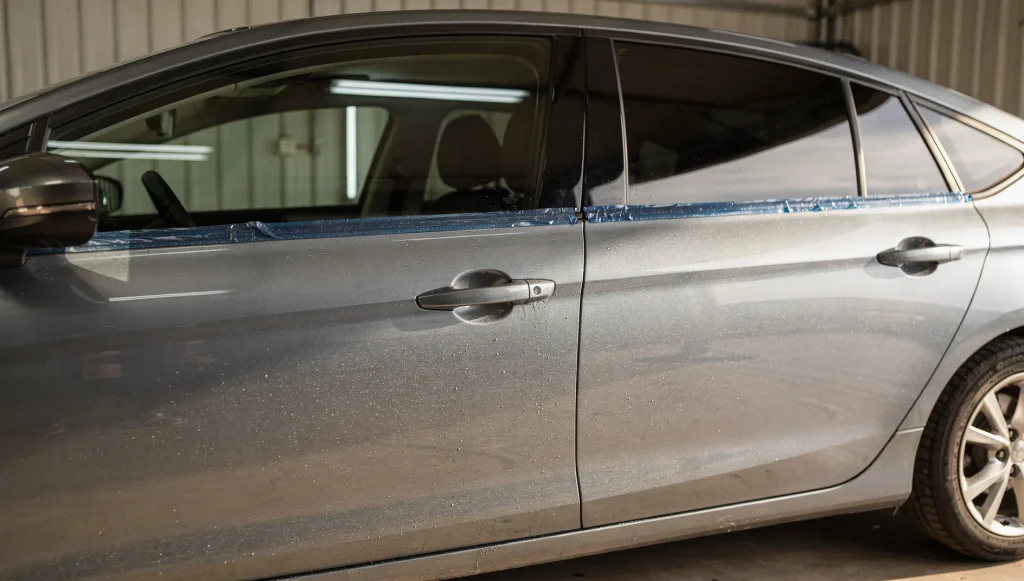
You run your hand across the bonnet of a car you have just washed and dried. It looks immaculate, but the surface feels gritty, almost like fine sandpaper. If you have ever wondered why car paint feels rough after washing, you are not imagining it, and you are certainly not alone. This exact frustration is something the exterior detailing specialists at MS Premier Detailing see every week, because a clean-looking finish and a smooth finish are two very different things.
That rough texture tells you something important about the condition of your paint. It is a diagnosis you can make yourself, and once you understand what is happening, the fix becomes obvious.
Prefer to watch or listen?
What That Rough, Gritty Feel Actually Is
The roughness you feel is bonded surface contamination sitting on top of the clear coat. These are tiny particles that have landed on your paint over weeks and months and physically attached themselves to the surface.
Water and shampoo slide straight past them. A wash is designed to float away loose dirt and dust, but these contaminants are not loose. They are anchored. Each one creates a microscopic bump, and when thousands of them cover a panel, your fingertips register the result as grit.
Importantly, this has nothing to do with whether your car looks dirty. Many of these particles are too small to see against the paint, which is why a vehicle can appear perfectly clean and still feel coarse to the touch.
Why Even a Careful Wash Cannot Remove It
It is tempting to assume a more thorough wash, a stronger shampoo, or more scrubbing will eventually smooth things out. It will not.
Washing removes contaminants that rest loosely on the surface. Embedded particles are a different problem entirely. They are mechanically stuck to the clear coat, so the only way to lift them is with a method that physically shears them off without dragging them across your paint.
That step is called mechanical decontamination, and it is the part of the cleaning process most people never do. A regular wash and a decontamination treatment solve two separate problems, which is why one can never replace the other.
The At-Home Smoothness Test
You can confirm contamination in seconds using a simple test that detailers rely on.
- Wash and dry a section of the car as you normally would, so you are not feeling ordinary dirt.
- Place your hand inside a thin plastic sandwich bag.
- Glide your fingertips lightly over the paint through the bag.
The bag amplifies texture your bare skin might miss. If the surface feels bumpy or rough rather than glassy, you have bonded contamination. A properly decontaminated panel feels completely smooth, like glass, with nothing catching under your fingers. Run the same test afterwards and the difference is unmistakable.
Common Sources of Embedded Particles in Perth
Living and driving around the Perth metro area exposes paint to a steady supply of airborne and road-borne debris. Over time, several sources settle onto the surface and bond to it:
- Road grime thrown up from bitumen, especially during longer commutes along major routes.
- Brake dust that drifts onto lower panels and wheels in heavy traffic.
- Industrial fallout near commercial and port areas, where fine particles circulate in the air.
- General airborne debris such as pollen, tree sap mist and construction dust.
Some of these particles are ferrous, which overlaps with the broader subject of iron fallout and stubborn tar deposits. But the rough feel most owners notice comes from the whole mix of embedded contaminants, not any single type.
How Clay Restores a Smooth Finish
Mechanical decontamination is most commonly done with a detailing clay bar or clay mitt, used together with a dedicated lubricant. The lubricant is the key. It creates a slick barrier so the clay glides across the paint and lifts particles into itself rather than grinding them along the clear coat.
As the clay passes over a panel, it grabs each bonded particle and pulls it free. Done correctly, with plenty of lubrication and light pressure, this process removes contamination without harming the clear coat beneath. Skipping the lubricant or pressing too hard is where problems happen, which is why technique matters more than effort.
After claying, the paint should pass the smoothness test cleanly. Many people are genuinely surprised at how different their car feels, often for the first time since it was new.
How Often Decontamination Is Worth Doing
Decontamination is not a weekly job. For most vehicles, doing it once or twice a year keeps the surface feeling smooth, though cars parked outdoors or driven through heavy traffic may need it more often.
A protected surface stays smooth for longer. When paint carries a layer of protection, contaminants find it harder to bond in the first place, so they rinse away more easily during normal washing. That means fewer rough patches between treatments and less work overall.
Of course, no finish stays glass-smooth on its own. Even freshly decontaminated paint begins collecting new contaminants the moment it goes back on the road, and that process accelerates for vehicles near the coast. Around Fremantle, salt-laden moisture drifts in off the water and settles constantly onto paint and bright metalwork, quietly attacking the very finishes you have just worked to protect. Understanding how that ocean air affects your paint and chrome is the next piece of keeping a car smooth and protected year-round.