
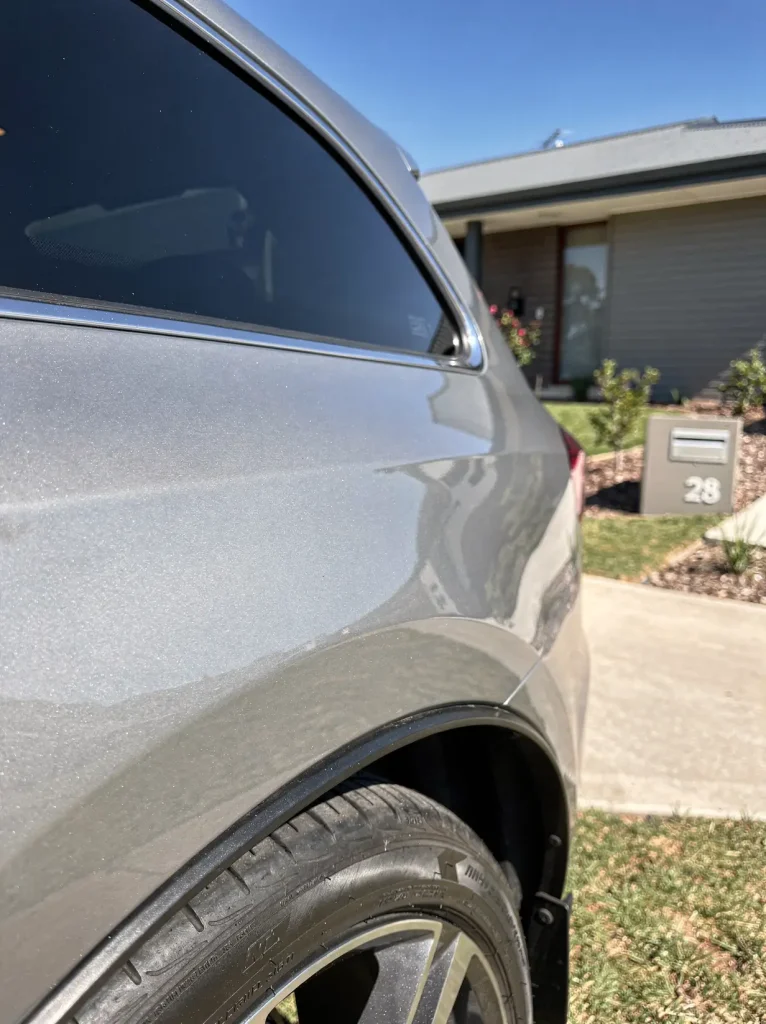
Most car owners have stood in this exact spot: unsure whether they’re about to pay for more service than their car needs, or whether a quick tidy-up will leave real problems untouched. It’s an easy question to get wrong, because the right answer has less to do with how a service is named and more to do with the actual state of the vehicle. This is one of the most common things we get asked when providing car detailing in Fremantle, WA, and the honest reply almost always starts with looking at the car itself.
Before going further, it helps to already understand that detailing sits well above a basic wash in both depth and outcome. If that distinction still feels fuzzy, it’s worth reading up on how a proper detail differs from a standard car wash first. From there, the choice between service tiers becomes much clearer.
Prefer to watch or listen?
Listen onApple Podcasts
What a Mini Detail Actually Addresses
A mini detail is best understood as maintenance. It’s designed to keep a car that’s already in decent shape looking sharp, without the deep correction work a heavily neglected vehicle would need.
The scope is focused: a thorough exterior clean, wheels and tyres, a general interior wipe-down and vacuum, glass, and the visible surfaces you interact with every day. The goal is to reset the car to a clean baseline rather than reverse months of accumulated wear.
The mindset behind it is regularity. A mini detail done often keeps contaminants from bedding in, which is why owners who stay on top of it rarely reach the point of needing anything more intensive. It suits daily drivers that get washed reasonably often and haven’t been left to deteriorate.
What a Full Detail Covers and Why It Exists
A full detail exists for cars carrying real, accumulated wear – the kind a surface clean simply can’t touch. Instead of maintaining a good baseline, it works to restore one.
That means a far deeper approach: decontaminating the paint, addressing embedded grime, treating and cleaning interior surfaces properly, and correcting or reducing defects that have built up over time. It’s a slower, more involved process because it’s dealing with problems that have had months or years to settle in.
If your car hasn’t been detailed in a long while, has visible paint issues, or has an interior that’s beyond a quick wipe, this is the tier built to handle it.
Reading Your Car’s Condition
You don’t need to be an expert to gauge which way your car leans. A few honest observations usually tell the story:
- Run your hand over the clean, dry paint – if it feels rough or gritty, contamination has bonded to the surface.
- Look at the paint under direct light for swirl marks, dullness, or faded patches.
- Check whether interior stains, odours, or built-up grime respond to a normal clean or keep coming back.
- Consider how long it’s been since the car had any serious attention beyond a wash.
- Notice whether problems are cosmetic surface dirt or something that’s clearly settled deeper.
If most of what you find is light and recent, a mini detail will likely do the job. If several of these point to entrenched wear, the car is asking for a full detail.
How WA Conditions Change the Equation
Local cars face pressures that speed up the whole cycle. Perth’s strong UV fades and degrades paint and interior surfaces faster than a milder climate would. Coastal air around Fremantle carries salt that clings to panels and accelerates corrosion risk if it’s left sitting. Add the fine dust common across WA summers, and contaminants build up quicker than many owners expect.
The practical effect is that a car here can slide from “just needs maintenance” to “needs correction” faster than one kept inland or in cooler conditions. It also means regular mini details carry more value locally, because they intercept salt and grime before they cause lasting damage.
Matching the Service to Your Goal
Your intention matters as much as the car’s condition. Three common scenarios point in clear directions:
- Routine upkeep: a well-kept daily driver you want to keep looking good leans toward a mini detail on a regular schedule.
- Restoring a neglected car: a vehicle that’s been ignored for a long stretch needs the depth of a full detail to genuinely reset it.
- Preparing for sale: a full detail makes the strongest case here, presenting the car at its best and removing the wear buyers instinctively notice.
The Cost of Choosing Wrong
Getting the match wrong cuts both ways. Book a mini detail on a car that needs correction, and you’ll spend money without solving the underlying problems – the swirls, embedded grime, and faded finish will still be there afterwards. Book a full detail on a car that only needed light upkeep, and you’ve paid for depth the vehicle didn’t require.
The point isn’t that one tier is better than the other. It’s that each is built for a different starting condition, and value comes from matching the service to where your car genuinely sits.
Once you’ve worked out that your car does call for the deeper option, the natural next question is what that actually involves – the specific stages and components that make up a comprehensive detail from start to finish. Understanding everything a complete detailing service includes makes it far easier to know what you’re paying for and why each step matters.